
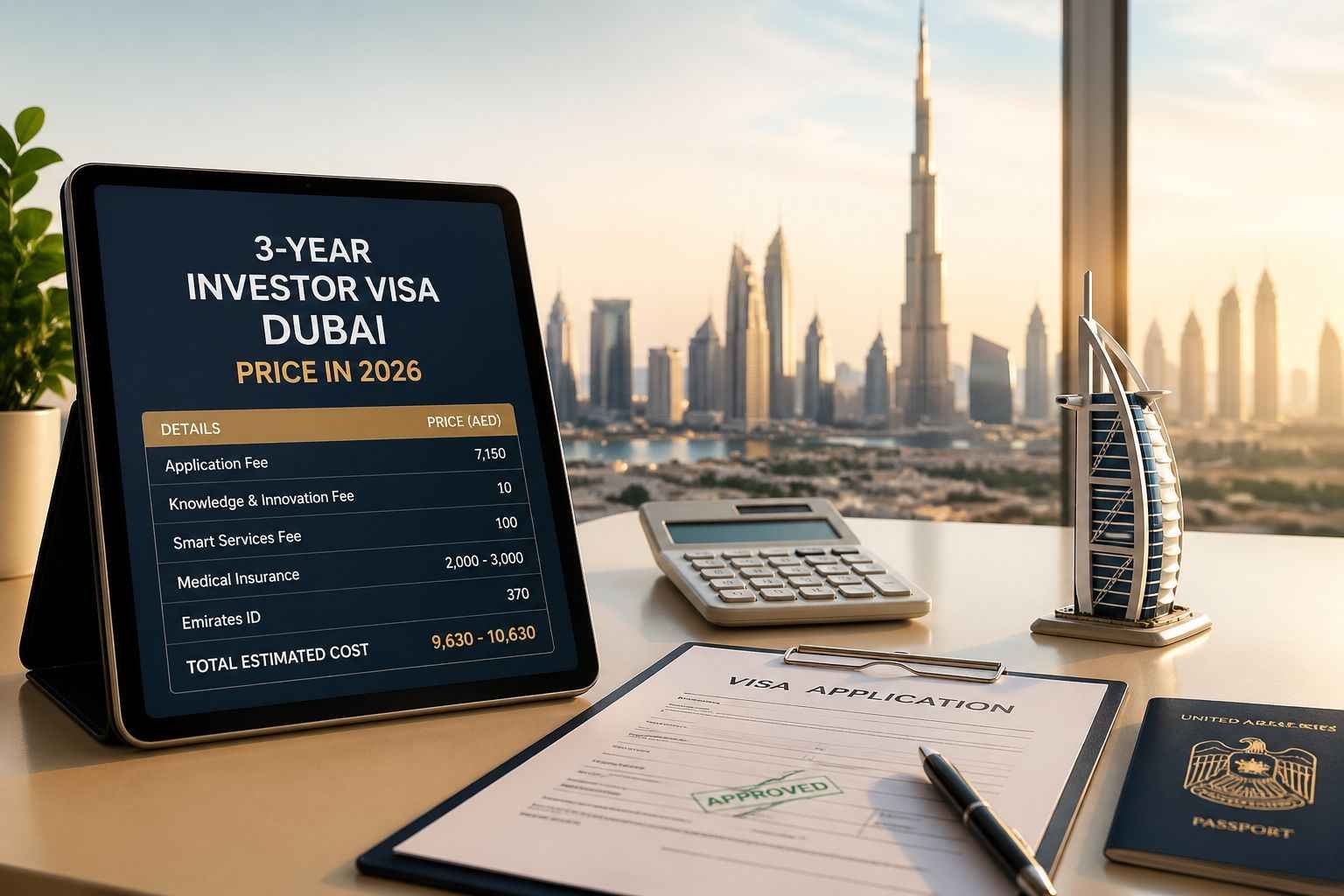
Dubai continues to attract global investors with its stable economy, tax-friendly environment, and strong real estate and business infrastructure. Among its long-term residency options, the 3-year investor visa remains one of the most practical choices for entrepreneurs and property investors who want legal residency without committing to permanent relocation.
However, in 2026, the real cost of this visa is not just a single fixed government fee. Instead, it is a combination of multiple charges that depend on the type of investment, application method, and level of professional assistance used during the process.
This guide breaks down the full cost structure in a clear and practical way so investors can understand what they are actually paying for.
Understanding the 3-Year Investor Visa in Dubai
The 3-year investor visa is issued to individuals who invest in UAE-based businesses or real estate properties that meet specific eligibility requirements. It allows long-term residency, business activity, and access to banking and investment opportunities within the country.
Unlike short-term visas, this residency type is closely linked to financial contribution and compliance checks, which directly influence the overall cost structure.
For broader regional travel and residency information, you can explore UAE travel and visa insights which provide additional context on living and investing in the region.

Real Cost Breakdown of the Investor Visa
The total price of a 3-year investor visa in Dubai in 2026 typically ranges between USD 3,000 and USD 7,500. This variation depends on how the application is handled and the type of investment involved.
Instead of a single payment, the cost is distributed across several mandatory and optional components that together form the full expense.
Main cost components include:
- Government visa application and issuance fees
- Medical fitness test charges required for residency approval
- Emirates ID registration and biometric processing
- Investment verification and documentation review costs
- Optional consultancy or PRO service fees
Each of these elements plays a role in determining the final amount paid by the investor.
How the Visa Cost Is Structured Over Time
The investor visa process is not completed in a single transaction. Instead, it follows a staged structure where payments are made at different points during approval and residency activation.
This process typically follows four key phases:
Phase 1: Initial application submission and eligibility assessment
Phase 2: Investment verification and document authentication
Phase 3: Visa stamping and residency approval
Phase 4: Medical test completion and Emirates ID issuance
Each stage may involve separate charges, especially if professional assistance is used to speed up the process or reduce administrative delays.
Detailed Breakdown of Cost Categories
To better understand how the total cost is structured, it is useful to divide expenses into clear categories based on their function.
Government Charges: These are mandatory fees set by UAE immigration authorities and apply to all applicants regardless of investment type.
Service Charges: Many investors use consultancy firms or PRO agents who handle paperwork, approvals, and coordination with government departments.
Medical and Identification Costs: These include compulsory health checks and Emirates ID processing, both of which are required for residency approval.
For investors comparing global relocation systems, international visa cost guides can help provide useful cost benchmarks.
Why Investor Visa Costs Are Not Fixed
One of the most important things to understand is that no two applicants pay exactly the same amount. The final cost depends on multiple real-world factors.
These include:
- Type of investment (property investment vs business ownership)
- Whether a visa consultant or PRO service is used
- Speed of processing (standard or fast-track applications)
- Level of documentation support required
These variations make the visa system flexible but also less predictable in terms of total cost.
Investor Cost Flow Explained Simply
Instead of viewing the visa as a single expense, it is more accurate to see it as a structured process that unfolds over time.
The cost journey typically looks like this:
Step 1: Application submission and initial processing fee
Step 2: Investment verification and eligibility confirmation
Step 3: Residency approval and visa stamping
Step 4: Final registration including medical test and Emirates ID
This phased structure helps explain why costs appear in multiple stages rather than one payment.
Hidden Costs Investors Often Overlook
While official fees are clearly defined, some additional costs are not always considered during planning. These can increase the total budget if not prepared for in advance.
- Translation and notarization of legal documents
- Courier and administrative handling charges
- Bank account opening and compliance requirements
- Renewal-related expenses after the 3-year period
Although individually small, these costs become significant when combined.
Is the 3-Year Investor Visa Worth It?
From a financial perspective, this visa is not just a residency document—it is an investment gateway. It provides access to one of the world’s most dynamic business ecosystems, with opportunities in real estate, trade, and entrepreneurship.
For most investors, the long-term benefits of stability, tax advantages, and market access outweigh the initial cost of obtaining the visa.
Final Thoughts
The 3-year investor visa Dubai price in 2026 should be understood as a structured financial process rather than a fixed number. It includes government charges, service fees, medical requirements, and optional professional support costs.
When planned properly, this visa becomes less of an expense and more of a strategic step toward long-term investment and residency in the UAE.
Ultimately, success with this visa depends on understanding both the financial structure and the process behind it, allowing investors to make informed and confident decisions.
Related Reading: 90 Days Visa Dubai Price in 2026: Visa Charges and Fee Guide
Related Reading: 2 Year Visa for Dubai Price in 2026: Visa Charges and Fee Guide
Related Reading: Dubai Visa Price Sri Lanka in 2026: What You Need to Pay — full guide